Bwer Pipes High-Density Polyethylene (HDPE) PE100
The absolute benchmark for municipal water networks, natural gas pipelines, and heavy industrial sewerage across all Iraqi governorates. Manufactured from 100% virgin bimodal polymer resins, Bwer Pipes guarantees zero-leakage, structural ductility, and a 100-year operational service life under Iraq's hot soil formations.
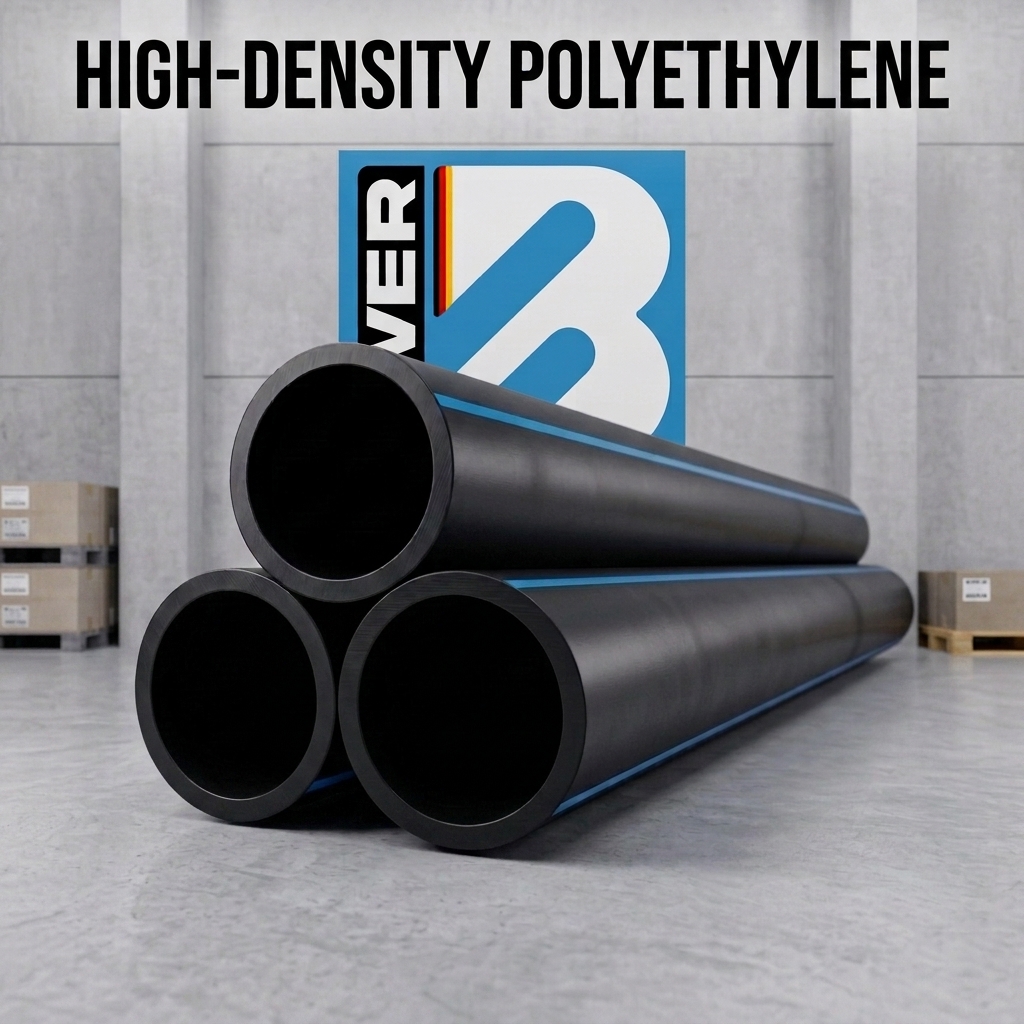
The High-Density Polyethylene (HDPE) Advantage by Bwer Pipes
Discover why Bwer Pipes is recognized as the leading and most trusted High-Density Polyethylene (HDPE) PE100 piping manufacturer in Iraq, trusted by municipal water directorates and national utility developers.
100% Leak-Free Fusion Joints
Unlike traditional PVC or ductile iron pipes that rely on mechanical rubber gasket joints prone to shift and leak under Iraqi soil movements, Bwer Pipes High-Density Polyethylene (HDPE) PE100 pipes are joined using butt-fusion or electrofusion. This creates a homogeneous molecular bond that is stronger than the pipe itself, eliminating water loss completely.
Extreme Weather & UV Shielding
Iraq's severe summer temperatures exceeding 50°C pose high degradation risks to plastic pipelines. Bwer Pipes infuses a minimum of 2.5% premium, finely dispersed Carbon Black into the PE100 polymer, providing maximum UV resistance and preventing thermal embrittlement during outdoor storage.
Outstanding Soil & Seismic Flexibility
With excellent flexibility and a bending radius up to 20-25 times the outer diameter, Bwer High-Density Polyethylene (HDPE) pipes absorb soil settlement, heavy traffic vibrations on municipal roads, and seismic activities without cracking, reducing the need for costly directional fittings.
Zero Corrosion & Internal Scaling
Bwer High-Density Polyethylene (HDPE) is chemically inert and completely immune to biological build-up, rusting, and chemical attacks from acidic or alkaline soil profiles in central and southern Iraq. It maintains a perfectly smooth interior (Hazen-Williams C factor of 150) for life, reducing pumping energy costs.
Trenchless Technology Compatible
Designed to handle high tensile stress, Bwer High-Density Polyethylene (HDPE) pipes are optimal for modern trenchless installation methods such as Horizontal Directional Drilling (HDD) and pipe bursting, minimizing public disruption and excavation costs in busy Iraqi municipal centers.
Long-Term Economics
With an operational life expectancy exceeding 100 years, Bwer High-Density Polyethylene (HDPE) pipes require virtually zero maintenance. Their lightweight structure facilitates faster installation timelines, translating to massive cost savings for infrastructure contractors.
Raw Material Sourcing: Dow & Borouge Polymers
Quality is not just inspected; it is built into the molecular structure of the pipe. Bwer Pipes manufactures its High-Density Polyethylene (HDPE) PE100 piping systems utilizing exclusively premium, prime-grade virgin bimodal resins sourced from global petrochemical pioneers.
Dow Chemical & Borouge Partner Resins
Unlike budget competitors in Iraq who mix recycled plastic waste, industrial scraps, or low-grade unimodal resins into their extrusion lines, Bwer Pipes enforces a zero-recycled policy for pressure pipes. We import 100% certified virgin bimodal compounds directly from Dow Chemical (USA) and Borouge (UAE/Austria).
These bimodal resins feature a unique molecular structure that combines low molecular weight (LMW) polymer chains for easy processing and high molecular weight (HMW) polymer chains for extreme mechanical strength. The result is a pipe with exceptional long-term hydrostatic strength (LTHS) and superior resistance to environmental stress cracking.
Dow CONTINUUM™ Resin
Bimodal technology providing excellent slow crack growth (SCG) resistance and rapid crack propagation (RCP) protection.
Borouge BorSafe™ HE3490-LS
Pre-compounded PE100 containing 2.5% finely dispersed Carbon Black, specifically optimized for long-term hot climate UV resistance.
Why Virgin Bimodal Material Matters in Iraq
Iraq's heavy soil profiles, dynamic traffic loads, and extreme thermal cycles place massive mechanical stress on underground pipelines. Low-grade unimodal or recycled pipes suffer from brittle failure modes due to micro-fissure expansion.
By utilizing virgin bimodal compounds, Bwer Pipes guarantees that the pipeline preserves its mechanical and chemical integrity under pressure, even in high-salinity water conditions typical of Basra, Najaf, and the southern marshes.
Every batch of Bwer High-Density Polyethylene (HDPE) pipes is logged and traceable back to the specific polymer raw material batch certificate from Dow or Borouge, complete with material melt index logs.
Material Characteristics & Mechanical Properties
Bwer Pipes High-Density Polyethylene (HDPE) PE100 systems are engineered to withstand complex physical and mechanical stress. The table below represents the validated laboratory properties of our raw compounds.
Long-Term Hydrostatic Strength (MRS 10.0)
The mechanical performance of Bwer High-Density Polyethylene (HDPE) PE100 is defined by the Minimum Required Strength (MRS) rating of 10.0 MPa at 20°C over a 50-year design lifetime. When designing drinking water networks or natural gas grids, engineers apply a standard safety design coefficient (typically 1.25 for water and 2.0 for gas) to establish the Maximum Allowable Operating Pressure (MAOP).
By testing our pipes under ISO 1167 hydrostatic protocols (running up to 10,000 hours of continuous loading), we verify that our bimodal polymers prevent slow crack propagation even when exposed to high-frequency pressure surges in municipal networks.
Physical Properties
- Density (Base Resin) ≥ 0.958 g/cm³ (ISO 1183)
- Melt Flow Rate (MFR) 0.2 - 0.4 g/10 min (ISO 1133)
- Carbon Black Content 2.0 - 2.5 % (ISO 6964)
- Carbon Black Dispersion Grade ≤ 3 (ISO 18553)
- Volatile Content ≤ 350 mg/kg (EN 12099)
Mechanical Properties
- Minimum Required Strength 10.0 MPa (ISO 9080)
- Tensile Yield Stress ≥ 23 MPa (ISO 527-2)
- Elongation at Break ≥ 600 % (ISO 527-2)
- Slow Crack Growth (SCG) > 1000 hours (ISO 13479)
- Flexural Modulus 1000-1200 MPa (ISO 178)
Thermal Properties
- Thermal Stability (OIT) ≥ 20 min (ISO 11357-6)
- Linear Thermal Expansion 0.18 mm/(m·K) (DIN 53752)
- Thermal Conductivity 0.40 W/(m·K) (DIN 52612)
- Vicat Softening Temp ≥ 74°C (ISO 306)
- Longitudinal Reversion ≤ 3% (ISO 2505)
Elastic & Dynamic Design Reference Values
Seismic & Ground Movement Resistance
Iraq's northern regions (along the active Zagros fault belt in Erbil, Sulaymaniyah, and Duhok) and the southern clay soils present major challenges for rigid pipelines. Shifting soil structures, clay swelling, and seismic activity easily fracture concrete or ductile iron.
Bwer High-Density Polyethylene (HDPE) PE100 features high ductility and tensile strain capacity. This flexibility allows the pipeline to stretch, bend, and absorb dynamic ground displacement without shearing. Under seismic events, the homogeneous fused joints ensure the network remains 100% leak-free, making it the safest municipal infrastructure solution.
High Elastic Strain
Withstands up to 600% elongation at break, allowing pipelines to deform safely without brittle failure during earth settlement.
Earthquake Dampening
Absorbs shockwaves and seismic vibrations, reducing kinetic stresses transmitted along the pipe structure.
Understanding SDR & Nominal Pressure (PN)
Choosing the right pipe for water or gas networks requires understanding the relationship between the Standard Dimension Ratio (SDR) and the Nominal Pressure (PN). SDR is a dimensionless numerical value calculated by dividing the nominal outside diameter (OD) by the nominal wall thickness.
A lower SDR value indicates a thicker wall relative to its diameter, which translates directly to higher pressure-bearing capabilities. For example, an SDR 11 pipe has a much thicker wall and is rated for PN16 (16 Bar), while an SDR 26 pipe has a thin wall rated for PN6 (6 Bar).
Extreme high pressure applications, mining, and industrial process loops requiring safety limits up to 25 Bar.
The municipal standard for drinking water mains and distribution networks inside Iraqi cities.
Ideal for sub-mains, wastewater pumping lines, and medium-pressure industrial networks.
Commonly selected for agricultural drip sub-mains and gravity-fed flow drainage systems.
Iraq Ambient Temperature Derating Guidelines
Standard pressure ratings (PN) are calculated for 20°C. For projects in Central and Southern Iraq where soil temperatures can reach 35°C-40°C, the maximum operating pressure must be derated to maintain the 50-100 year design lifetime safety factor:
Comprehensive SDR Dimension Matrix
Manufactured to meet strict ISO 4427 criteria, our dimension range extends up to 2000 mm in diameter, making Bwer Pipes the largest capacity extruder in Iraq. Below is the nominal wall thickness matrix across standard pressure ratings.
* Values represent nominal wall thicknesses in millimeters (mm) per ISO 4427 guidelines. Sizes and pressure ratings out of this standard table can be produced based on special contract parameters.
Material Comparison Matrix
See how Bwer High-Density Polyethylene (HDPE) PE100 compares against alternative piping materials across key engineering and financial parameters.
Total Cost of Ownership (TCO) Comparison
When specifying infrastructure piping for projects in Baghdad, Erbil, or Basra, engineers must evaluate the Total Cost of Ownership (TCO) rather than simply comparing initial material price tags. Traditional materials like Ductile Iron (DI) and Carbon Steel (CS) appear robust but incur massive costs over time due to cathodic protection requirements, heavy crane logistics, high rates of joint failure, and pumping friction losses.
Bwer High-Density Polyethylene (HDPE) PE100 pressure pipes eliminate these recurring maintenance liabilities. With a verified 100+ year operational lifespan and zero leakage joints, they represent the most economically efficient infrastructure selection for municipal public works in Iraq.
Handling, Transport & Storage under Iraq's Hot Sun
Preventing Thermal Deformation & Scoring
While Bwer High-Density Polyethylene (HDPE) pipes are infused with premium Carbon Black stabilizers to resist UV radiation, Iraq's extreme summer climate—where solar radiation can heat dark plastic surfaces to over 70°C—requires careful site storage.
Pipes must be stored on flat, level ground free of sharp stones or debris. They should be supported by flat wooden packing blocks (minimum 75mm width) spaced no more than 1 meter apart. This support prevents localized sagging and ensures the pipe maintains its circular profile. Stacking heights should be limited to 1.5 meters, or a maximum of 3 layers for larger diameters, to prevent ovality deformation in the bottom layers.
Important Handling Rule: Never drag pipes over rocks, gravel, or asphalt. Any score or groove that cuts deeper than 10% of the pipe wall thickness represents a failure risk under pressure and must be cut out prior to joint welding.
To reduce freight costs when shipping long distances across Iraqi governorates, smaller diameter pipes can be nested inside larger ones. Ensure that only wide textile webbing straps (not chains) are used to tie down load bundles.
1. Stacking Height Limits
Keep stack heights below 1.5 meters to distribute weight evenly and prevent bottom pipe ovality under ambient summer heat.
2. Non-Metallic Sling Lifting
Always lift pipe bundles using wide, flat textile web slings. Never use wire ropes, steel chains, or forklift tines directly inside the pipe ends.
3. Sun Cover & Ventilation
While UV protected, long-term outdoor storage stacks should be covered with ventilated canvas to allow air circulation and prevent heat traps.
4. Pipe End Protection
Keep temporary protective end caps on pipes until the moment of welding to prevent dust, wind-blown sand, and gravel from entering the pipe.
Hydraulic Pressure Loss & Flow Capacity Design
Technical guidance for municipal water engineers designing pump stations, main lines, and high-flow loops in Iraq.
Smooth Interior Surface & Lifetime Flow Efficiency
High-Density Polyethylene (HDPE) PE100 pipes feature an exceptionally smooth inner wall (absolute roughness k = 0.007mm per Colebrook-White). This smooth surface prevents the accumulation of scale, calcium carbonate, or biological buildup, commonly found in Iraq's municipal hard water networks.
This allows engineers to use a constant Hazen-Williams friction factor of C = 150 for the lifetime of the network. In comparison, ductile iron or carbon steel pipes corrode internally, causing their friction factor to drop to C = 100 or lower within 10 years of service, causing a massive increase in pump pressure head loss.
Catastrophic Surge (Water Hammer) Mitigation
Due to the high elasticity of bimodal PE100 (elastic modulus approx 1,000 MPa), pressure surge wave speeds are significantly lower (approximately 250 m/s to 300 m/s) compared to carbon steel (over 1,200 m/s) and ductile iron (over 1,000 m/s). This elasticity reduces transient water hammer surge pressures by up to 75%, preventing sudden joint ruptures during valve operations.
Friction Head Loss Comparison (Per 1000m)
* Friction calculations are based on the Hazen-Williams equation assuming continuous clean water transport. Colebrook-White formulas are recommended for high viscosity or chemical slurry designs.
Jointing & Fusion Guidelines
Correct installation is vital. Our engineers recommend three primary jointing technologies to guarantee leak-free operation over a 100-year cycle, fully compliant with international DVS 2207 protocols.
The Power of Homogeneous Molecular Joints
Unlike metallic pipes that rely on mechanical couplers or gaskets which decay over time, High-Density Polyethylene (HDPE) pressure systems are joined via thermofusion. When heated to molten state and joined under pressure, the polymer chains of the two pipe ends intertwine and crystallize together as they cool, forming a single, continuous structure. The weld joint is structurally stronger than the pipe body itself.
Butt-Fusion
Size ≥ 90mmThe primary field method. Pipe ends are clamped in a hydraulic fusion machine, shaved flat with a rotating planer, heated via a PTFE-coated plate, and pressed together until cooled under strict pressure profiles.
- Plate Temperature: 210°C to 230°C
- Alignment Mismatch: < 10% wall thickness
- Heater plate removal time: < 5-10 seconds
- Cooling Phase: Under full pressure until cool
Electrofusion
Ideal for RepairsUses custom polymer fittings containing internal copper heating coils. A programmed electrical current melts the outer layer of the pipe and the inner layer of the fitting to create a leak-proof sleeve.
- Mechanical Scraping: Remove 0.2mm oxide layer
- Aligner Clamps: Prevent joint displacement
- Dry Joints: Zero moisture on fusion face
- Cooling Period: Keep clamped until fully cold
Flanged Stub
TransitionsUsed to connect High-Density Polyethylene (HDPE) lines to steel gate valves, municipal pump stations, and existing metal pipe networks. Employs a butt-fused stub end combined with a backing ring.
- Gaskets: EPDM rubber with steel core insert
- Tightening: Star pattern diagonal sequence
- Corrosion Protection: Hot-dip galvanized bolts
- Torque Limit: Specific limit based on diameter
Fittings & System Components Range
A pipeline system is only as reliable as its connection components. Bwer Pipes manufactures and imports a comprehensive suite of bimodal High-Density Polyethylene (HDPE) PE100 fittings to ensure full system compatibility and lifetime performance.
Butt-Fusion Fittings
Spigot fittings designed for direct welding with butt-fusion machinery. Includes equal tees, reducing tees, 90-degree and 45-degree elbows, concentric and eccentric reducers, and stub ends.
Electrofusion Fittings
Precision-molded fittings with embedded heating coils. Includes electrofusion couplers, tapping tees, branch saddles, elbows, and transition couplers to ensure easy installation in confined trench profiles.
Stub Ends & Backing Rings
Flanged stub ends (stub adapters) and powder-coated steel backing flanges. Designed to transition smoothly from plastic HDPE pipelines to metal gate valves, strainers, or pumping stations.
Trench Preparation & Installation Guide
Trench Excavation and Bedding (EN 805 Compliant)
Proper trench setup is essential to maximize pipeline lifespan. The trench bottom must be excavated level and free from sharp stones, large clay clumps, or organic waste.
A minimum of 100mm sand bedding is recommended for standard installations (except when utilizing specialized Bwer PE100-RC crack-resistant pipes, which permit direct sandbed-free backfilling with native soils).
Trench Cover Depth Rules: To shield the pipeline from heavy vehicle dynamic loads, the minimum cover depth from the pipe crown to the ground surface must be at least 0.8 meters in non-traffic areas, and 1.2 meters under active roadways.
Backfilling should be conducted in 150mm lifts. Side support soil (embedment) must be compacted using hand stampers or vibro-rammers to reach a minimum of 95% Standard Proctor Density to prevent pipe ovality.
Trench Width Guidelines
Trench width should be nominal pipe diameter plus 300mm to allow safe compaction at the pipe sides.
Backfill Compaction Layering
Place backfill in 150mm layers, compacting each to 95% standard proctor density up to 300mm above the pipe crown.
Warning Tapes & Tracing Wires
Place warning ribbons with metallic tracing wires 300mm below soil surface to allow magnetic detection from above.
Critical Infrastructure Applications
Bwer High-Density Polyethylene (HDPE) PE100 pipes are designed and certified to transport liquids, gases, and slurries across various demanding environments in Iraq.
Municipal Drinking Water Networks
Certified 100% food-grade and safe for drinking water. Bwer pipes prevent biological colonization, scale buildup, and maintain optimal hygiene standards. Our pipes are fully approved for city network distribution schemes in Erbil, Sulaymaniyah, Baghdad, Basra, and all surrounding municipal zones.
High-Pressure Gas Distribution
PE100 high-density compounds provide the safety margins required for natural gas and LPG distribution lines. Extruded with a distinct yellow safety stripe for immediate identification. High resistance to cracking and pressure surge cycles makes it the safest choice for energy networks.
Industrial Sewage & Waste
With extreme chemical resistance ranging from pH 2 to pH 12, our pipes transport aggressive industrial chemicals, hazardous waste, and acidic drainage effluents without corroding or structural decay. Ideal for refineries and industrial zones.
Mining, Dredging & Slurry
The high abrasion resistance of Bwer PE100 pipes ensures reliable handling of abrasive sand, gravel, and ore slurries, making it superior to metal conduits in industrial quarrying and dredging operations in Basra's shipping channels.
Trenchless Rehabilitation (HDD)
Due to its high tensile strength and flexibility, Bwer HDPE PE100 is the ideal material for horizontal directional drilling (HDD) or slip-lining old failing concrete sewer lines without tearing up city streets or causing dynamic traffic delays.
Agricultural Water Distribution
Supporting Iraq's agricultural recovery (e.g. Ninewa plains, Babylon governorate) by transporting pressurized water over long distances with zero evaporation or soil absorption losses, resisting aggressive fertilizers and UV exposure.
Sustainability & Green Footprint
In modern infrastructure planning, reducing the environmental footprint is as critical as mechanical performance. Bwer High-Density Polyethylene (HDPE) PE100 pressure pipes are engineered with sustainability in mind, offering a lower environmental impact compared to metal or concrete pipelines.
Manufacturing High-Density Polyethylene (HDPE) requires significantly less energy than casting ductile iron or smelting steel. Furthermore, the lightweight nature of PE100 reduces transportation fuel consumption across Iraqi governorates. Bwer pressure pipes are 100% recyclable, cause zero heavy metal leaching into drinking water supplies, and prevent municipal water resource waste through zero-leak fused joints.
Lower Carbon Emissions
Requires less energy during manufacturing and transport compared to metallic alternatives, reducing total project carbon footprint.
Potable Water Safety
Chemically inert, releasing zero toxic chemicals, plasticizers, or heavy metals into drinking water mains.
Circular Economy
At the end of their 100+ year service life, Bwer pipes can be recycled back into industrial non-pressure applications.
Strict Quality Assurance Laboratory
Every production run of Bwer High-Density Polyethylene (HDPE) PE100 pressure pipes undergoes exhaustive destructive and non-destructive testing inside our ISO-compliant testing laboratory. No batch is released without a signed Mill Test Report (MTR).
Hydrostatic Strength Test
Pipes are pressurized inside specialized water baths at 20°C (100 hours and 1000 hours) and 80°C (165 hours) to guarantee they withstand long-term operational hoop stress without creep failure.
Melt Mass-Flow Rate (MFR)
Verifies the raw material fluid behavior at 190°C under a 5.0 kg load. This ensures the bimodal resin preserves its structural chain integrity throughout the extrusion heat cycles.
Carbon Black Dispersion Test
Microscopic inspection of thin pipe sections to verify that the carbon black UV-stabilizer is uniformly distributed (Grade ≤ 3), preventing localized weathering spots.
Tensile Elongation at Break
Dumbbell specimens are pulled at constant speed until they break. We guarantee an elongation of ≥ 600%, ensuring extreme ductility under shifting soil zones.
Oxidation Induction Time (OIT)
Measures the polymer's thermal stabilization at 200°C in an oxygen atmosphere. We guarantee an induction time of ≥ 20 minutes, ensuring the pipe resists thermal aging.
Dimensional & Ovality Control
Pipes are continuously scanned with ultrasonic wall thickness sensors and checked with mechanical pi-tapes to confirm diameter tolerances and zero ovality deviations.
Iraq's Most Trusted Partner for Infrastructure
Proven Track Record Across Iraqi Governorates
Bwer Pipes is recognized as the largest and most technologically advanced manufacturer of High-Density Polyethylene (HDPE) systems in the Republic of Iraq. Our pipes form the core of water supply, agricultural, and industrial infrastructure networks across all governorates:
Official Ministerial Certifications
Our High-Density Polyethylene (HDPE) PE100 piping systems are fully certified, approved, and frequently specified for public utility works by central ministries and planning departments:
- Ministry of Construction, Housing, Municipalities & Public Works (Central Gov - Baghdad)
- Ministry of Water Resources (potable storage and irrigation projects)
- Kurdistan Regional Government (KRG) Ministry of Municipalities & Tourism
- ISO 9001:2015 Quality Management Systems certified production line
Frequently Asked Questions
Find professional answers to common questions about designing, welding, and installing Bwer High-Density Polyethylene (HDPE) PE100 pipes in Iraq.
Q1: What is the main difference between PE80 and PE100?
PE100 is a newer generation of bimodal resin with a higher density and a Minimum Required Strength (MRS) of 10.0 MPa at 20°C, compared to 8.0 MPa for PE80. PE100 pipes have thinner wall thicknesses than PE80 for the same pressure rating, which saves weight and increases internal diameter flow capacity.
Q2: How does temperature affect the pressure rating of High-Density Polyethylene (HDPE) PE100?
The standard pressure rating (PN) is established for an operating temperature of 20°C. For continuous operation at higher temperatures (e.g. up to 40°C in Iraq summers), the safe operating pressure must be derated by applying a temperature reduction factor (e.g. 0.74 at 40°C) to maintain safety margins.
Q3: How are High-Density Polyethylene (HDPE) pipes packaged and delivered?
Pipes with diameters up to 110mm can be delivered in continuous coiled rolls of 50m, 100m, or 200m to minimize joints. Larger diameters (125mm to 2000mm) are supplied in straight lengths of 6 meters or 12 meters to optimize standard logistics.
Q4: Are Bwer High-Density Polyethylene (HDPE) pipes safe for municipal drinking water?
Yes. Bwer Pipes manufactures High-Density Polyethylene (HDPE) pipes using 100% virgin food-grade PE100 raw materials. They contain no toxic additives or heavy metals, ensuring zero odor or taste changes in municipal drinking water lines.
Q5: What is the minimum bend radius for High-Density Polyethylene (HDPE) PE100?
At 20°C, the minimum bend radius for High-Density Polyethylene (HDPE) pipes is 20 times the outside diameter (20 x OD) for SDR 11/17 pipes. Under colder temperatures or high pressure, a bend radius of 25 x OD is recommended. This high flexibility eliminates the need for direction-change fittings.
Q6: Can High-Density Polyethylene (HDPE) PE100 pipes be connected to steel or PVC lines?
Yes, using transition adapters. We manufacture specialized backing flanges, stub ends, and compression steel-to-High-Density Polyethylene (HDPE) mechanical fittings that allow safe transition connections to cast iron, carbon steel, and PVC networks.
Q7: Can these pipes be installed under roadways?
Yes. If properly buried in accordance with engineering guidelines (soil depth of at least 1.0m to 1.5m and backfilled with compacted aggregate), High-Density Polyethylene (HDPE) PE100 pipes withstand heavy vehicle dynamic loading without deformation.
Q8: How long can Bwer High-Density Polyethylene (HDPE) pipes be stored outdoors?
Thanks to the carbon black UV stabilizer content (≥ 2.0%), Bwer High-Density Polyethylene (HDPE) pipes can be safely stored outdoors in direct sunlight for up to 2 years without any degradation in their mechanical properties.
Q9: What is the thermal expansion rate of PE100?
High-Density Polyethylene (HDPE) has a thermal expansion coefficient of approximately 0.18 mm per meter per degree Kelvin. This expansion is accommodated in underground layouts by soil friction, and in aboveground installations by utilizing expansion loops or guiding anchors.
Q10: Do you provide quality testing certifications with shipments?
Yes. Every batch of Bwer Pipes comes with official mill test certificates (MTC) indicating density, hydrostatic test results, MFR, and carbon dispersion values verifying compliance with ISO 4427.
Q11: What is the difference between PE100 and PE100-RC pipes?
PE100-RC (Resistant to Crack) uses modified polymer structures that provide high slow crack growth resistance. While standard PE100 requires sand bedding to prevent scratches from stones, PE100-RC can be installed bedding-free directly in native soils, saving sand procurement and excavation costs.
Request a Bulk Price Quote
Get direct factory pricing for your municipal, agricultural, or industrial piping project. We specialize in custom dimensions, specific SDR/PN pressure classes, and quick freight logistics across all of Iraq.